
Web Application Development Services: Off-the-Shelf or Custom Build?
How to decide between off-the-shelf software and a custom web application for a portal or business tool, and how to set a scope you can deliver.
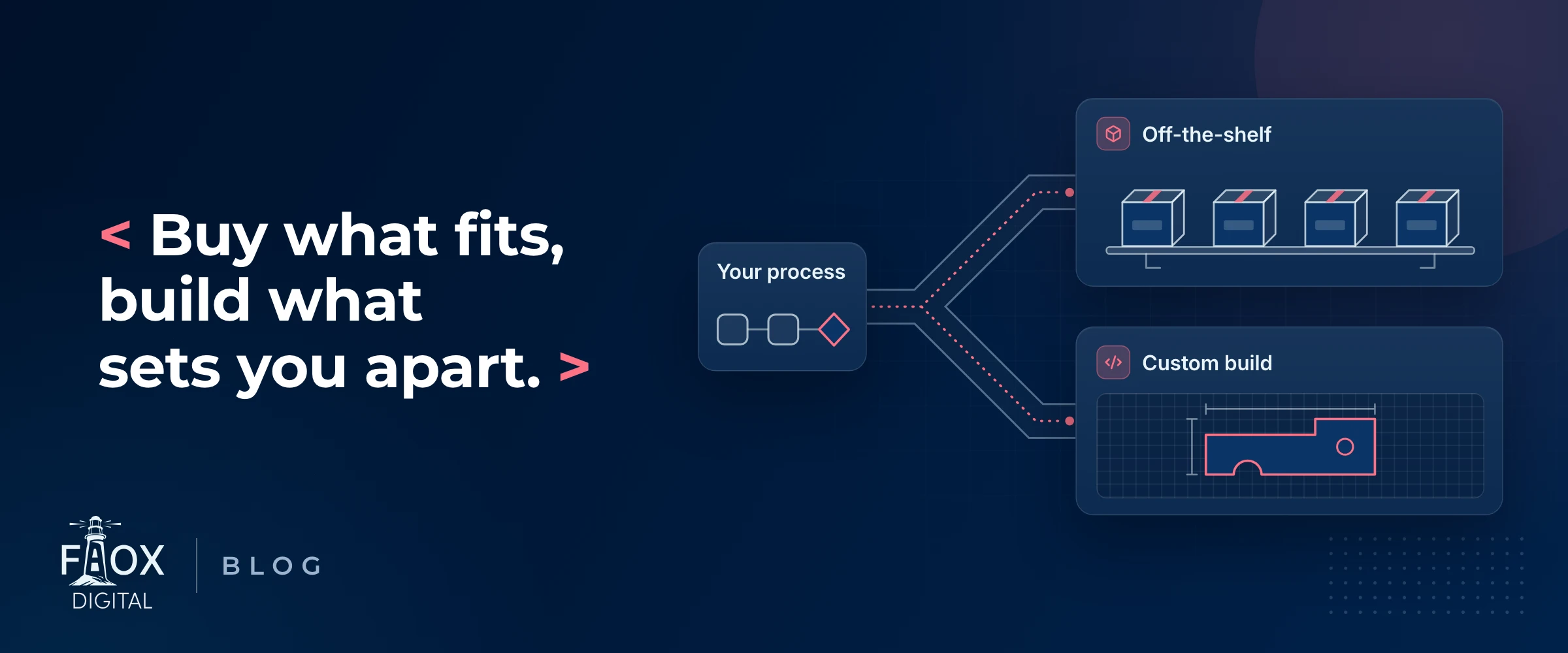
Choose off-the-shelf software when your process is close to how most companies work and a product covers your must-haves. Choose a custom build from web application development services when the application is part of how you compete, or when no product fits your rules and systems without constant workarounds. In between sits a standard platform extended with custom parts; whichever you choose, decide on total cost of ownership over several years, not on the first quote, and scope a first version you can deliver.
Once you know you need a portal, a configurator or another business application, the next question is whether to buy it or have it built. Software vendors and web application development services both have an interest in the answer. So do we: we work as a B2B website design agency, so we have a stake in the answer, and the checks below apply to any provider, including us.
This guide compares the options, explains what each one really costs and shows how to set a scope you can deliver. For what a web application is and when you need one, start with our web application development guide.
Off-the-shelf, configured or custom: three ways to get a web application
The choice is not always a pure buy or build. There are three realistic routes:
| Aspect | Off-the-shelf software (SaaS) | Configured platform | Custom build |
|---|---|---|---|
| What you get | A ready product, used as it is | A standard platform set up and extended for you | Software written around your processes |
| Fits when | Your process is common and the product covers your must-haves | A platform covers most needs, and the rest are your own rules | Your process is what sets you apart, or no product fits |
| Cost pattern | A subscription, often per user | Subscription plus setup and partner work | Build cost, then hosting and maintenance |
| Time to start | Fastest: sign up and configure | Middle: depends on setup and integrations | Slowest: build and test a first version |
| Control | The vendor’s roadmap | Shared | Yours, if the contract says so |
| Way out | Export your data | Export data, rebuild the custom parts | Take the code and data, if you own them |
Off-the-shelf software (SaaS) is software you rent and use through a browser, as it is or with settings. A configured platform is a standard product, such as a CRM or a commerce system, extended with your own fields, rules and screens. The same choice exists for websites, and our comparison of a custom website vs template covers it.
Before you commission anything, check what you already pay for. If the need is mostly accounts, service requests and partners, your CRM may cover it: HubSpot’s Service Hub, on its Professional and Enterprise plans, includes a support portal where customers manage their tickets, and Salesforce’s Experience Cloud is used to build partner portals, support forums and web applications. Our article comparing HubSpot and Salesforce looks at both.
What is custom web application development?
Custom development means software written for your processes, by your own team or by a provider of web application development services, instead of a subscription to a product. You decide how it works and what it connects to, and you carry the build cost and the upkeep.
It rarely means writing everything from scratch. Custom applications are assembled from frameworks, open-source components and cloud services, which is one reason the licenses of those parts, and the ownership of the result, need checking before you sign.
When off-the-shelf software is the better choice
Buying is the natural starting point for standard needs, and many companies already rent business software. In Eurostat’s 2025 survey, 67% of medium-sized EU enterprises (50 to 249 persons employed) and 85% of large ones paid for cloud computing services, and 42% of the large ones used CRM software as a paid cloud service.
Buy when:
- Your process is common. Ticket handling, standard ordering or partner registration work much the same in most companies.
- A product covers your must-haves with settings, not code. Every workaround you add makes later updates harder.
- You need it soon, and you would rather pay a subscription than own the upkeep.
Watch the terms. Per-user pricing that looks small for ten staff can grow quickly when hundreds of dealers log in. Read what the plan includes, how prices can rise and what the vendor’s roadmap promises, since you do not control it.
When a custom build is worth it
Build when:
- The application is part of how you compete, such as a configurator that carries your engineering rules or pricing logic no product can express.
- Your rules or systems do not fit. An older ERP, several systems to connect or approval steps that a product cannot model all push toward custom work.
- Licenses cost more than ownership at your scale. Many external users, or many locations, can tip the total cost of ownership.
- You need control over where the data lives, how security works or what gets built next.
A custom build also carries more risk of running late and over budget, as our web application development guide explains, which is why scope and the first version matter so much.
Total cost of ownership: compare years, not the first quote
Total cost of ownership is everything you will pay over the life of the application, and it is the only fair way to compare a subscription with a build. Put both options on the same period, such as five years, and include:
- License or subscription: per user, per site or per tier, with price increases and add-ons.
- Implementation: setup, data migration, training and your own staff’s time.
- Integration: connectors, middleware and the work on your ERP or CRM side.
- Hosting and maintenance: security fixes, updates, monitoring and support. Our article on what a monthly maintenance plan should cover breaks these costs down for websites.
- Changes: the new features you will want every year.
- Exit: exporting data, migrating and rebuilding custom parts if you ever leave.
For a sense of build cost, GoodFirms’ 2026 survey of more than 300 web development firms in 31 countries found that the most common estimate for a custom web application was $20,000 to $50,000, given by 35.5% of respondents; for a web portal, the same range was given by 33.6%. These are providers’ estimates across markets with very different hourly rates, so treat them as a range and not a price. Our article on what a website redesign costs explains how agencies build up a quote.
Scoping: decide what the first version must do
Scoping is where most of the cost is decided. Write down the users, the tasks they need to complete and the systems involved, then sort every requirement into Must have, Should have, Could have and Won’t have this time. That method, known as MoSCoW, is used in the DSDM agile framework, and the Agile Business Consortium recommends keeping must-haves to typically no more than 60% of the effort, with around 20% in could-haves as contingency.
The first version (MVP) then covers the must-haves for one user group and one task, as our web application development guide describes. Ask for it to be priced separately. Be careful with one fixed price for the whole wish list: the uncertainty has to go somewhere, either into a margin in the price or into change requests later.
Integration, scalability and maintenance
These three decide what happens after launch:
- Integration. With a product, you depend on the vendor’s APIs, connectors and their limits. With a custom build, you own the integration code and have to keep it working when your ERP or CRM changes.
- Scalability. A SaaS vendor scales the service for you. A custom application scales as far as its design and hosting allow, and B2B applications tend to grow in accounts, rules and integrations rather than in traffic.
- Maintenance. With a product, the vendor applies fixes and you maintain your settings. With a custom build, someone has to apply security fixes, update components and monitor the system for as long as it runs, and that cost belongs in the total from day one.
Project duration: what sets the timeline
Project duration depends less on the number of screens than on decisions and data: how many roles and integrations there are, how clean the data is, how quickly your side signs off each step and how many languages are needed. In GoodFirms’ 2026 survey, the most common timeline estimate for a custom web application was 8 to 16 weeks, given by 35.5% of respondents. A product can be running sooner, but configuration, data migration and training still take time.
Ownership and exit: check before you sign
Source code ownership is not automatic. Under US copyright law, for example, software commissioned from an outside firm is generally not a "work made for hire", because software is not among the categories of commissioned work the law lists, and copyright transfers only through a signed written instrument. Rules differ by country, so make the contract say it explicitly, and take legal advice.
Exit matters for products too. In the EU, the Data Act, which has applied since 12 September 2025, requires providers of cloud services, including SaaS, to set out switching rights in a written contract, including the right to move data to another provider. From 12 January 2027, they may not charge for switching. Services custom-built for one customer are partly exempt, so put exit terms in those contracts yourself.
- The contract says who owns the source code, designs and data, in writing
- You receive the code, build instructions and access to the code repository
- Hosting, domains and third-party accounts are in your company’s name
- You know which open-source and third-party components are used, and under which licenses
- For a product: you can export all your data in a usable format, and the switching terms are written down
- Someone has been named to maintain the application after launch
Choosing web application development services
If you decide to build, or to have a platform configured, the provider matters as much as the technology. Ask each one:
- Will you start with discovery and a written scope before you quote the build?
- Can you price the first version separately from later releases?
- How do you test security and performance, and who maintains the application after launch?
- Who owns the code, designs, data and accounts, and what do we receive at the end?
- Have you connected the systems we use, and can we speak to a client who has?
- Would something we already pay for, such as our CRM, cover part of this?
A provider that asks the last question unprompted is looking at your problem, not only at the project.
How Faox Digital approaches build or buy decisions
Faox Digital, a digital growth partner for B2B companies in complex and international markets, starts by learning what the company sells, who will use the application and which markets it serves, and maps what each screen has to do before anything is built. We scope web applications honestly and build only what will be used, and we suggest first steps that fit the company’s budget and stage. The client signs off each step before the next one begins, and the application is tested in every language and on every device before anyone outside sees it.
Key takeaways
- Buy when your process is common and a product covers your must-haves; build when the application is part of how you compete or no product fits.
- A standard platform extended with custom parts can be the middle path.
- Compare total cost of ownership over the same period, including integration, maintenance and exit.
- Keep must-haves to the effort you can deliver, and price a first version separately.
- Settle ownership of code, data and accounts, and the exit terms, in writing before you sign.
Frequently asked questions
What do web application development services include?
Usually discovery and scoping, design, development, testing and launch, followed by hosting, maintenance and support. Check which of these a quote covers, and whether integration with your ERP or CRM and data migration are included or priced separately.
Who owns the code when an agency builds our application?
Whoever the contract says, which is why it needs to say it. In the US, commissioned software is generally not a work made for hire, so ownership passes to you only through a signed written transfer, and other countries have their own rules. Ask for ownership or a clear license, the code itself and access to every account.
Can we start with off-the-shelf software and build later?
Yes, and it is often a sensible way to learn what you really need. Make sure you can export your data and that your processes do not depend on features you could not rebuild, so a later move stays possible.
Is SaaS cheaper than a custom build?
At the start, usually. Over several years it depends on the number of users, the price increases and the cost of workarounds, against the build, hosting and maintenance of your own application. Compare the total cost of ownership over the same period before you decide.
Sources
- GoodFirms: Website development cost 2026, updated October 2026
- Eurostat: Cloud computing services by size class of enterprise, 2025 survey
- EUR-Lex: Regulation (EU) 2023/2854, the Data Act, 2023
- Agile Business Consortium: What is MoSCoW prioritization?, accessed November 2026
Let’s talk
Planning a new website or a fix?
Send us your current site and what you need it to do. We will tell you whether it needs a rebuild or a few focused changes.